Screen auxetic metamaterials with leapsea
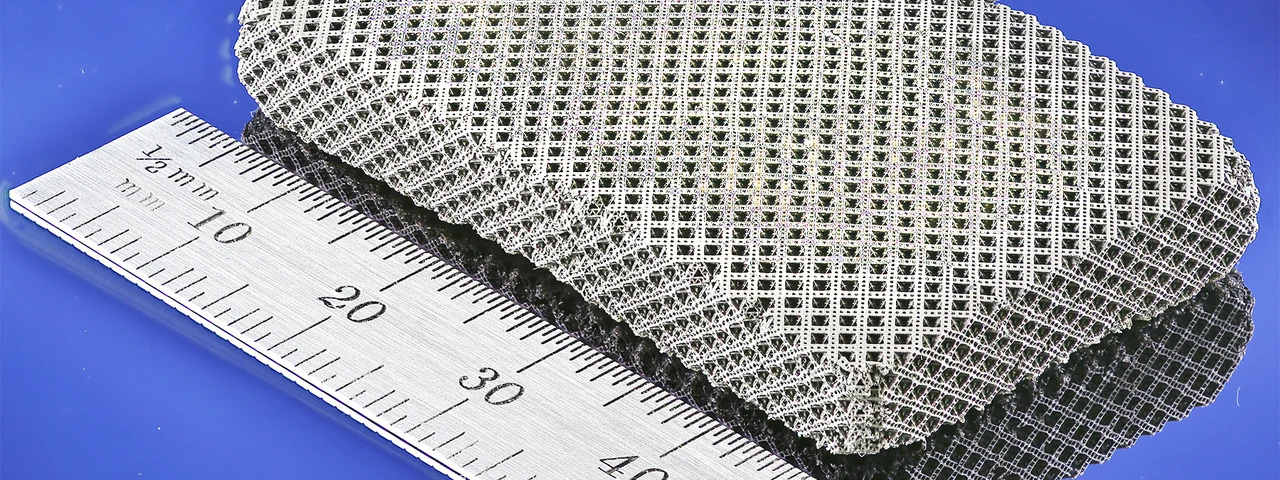
Parameterize a two-dimensional re-entrant lattice and combine a materials expert, literature and code connectors, finite-element skills and optimization to build a reviewable screening and candidate-validation workflow.
A lattice widening sideways during a single loading case leaves several questions open. Which material, geometry, load and boundary conditions produced that response? Does it persist with mesh refinement or a larger specimen? This workflow scopes the task to small-strain screening of two-dimensional re-entrant lattices and uses leapsea to organize geometry, solving, optimization and review.
Specify the structure and loading conditions
Create a local research task with parameterized re-entrant geometry, base-material elasticity, thickness assumptions, minimum strut widths and manufacturing constraints. One objective is a negative effective Poisson ratio under specified small-strain loading while retaining an agreed stiffness and relative-density range. Numerical bounds come from project requirements and fabrication conditions.
NIST's auxetic-material research illustrates how structural organization can produce this response. Start here with a finite lattice specimen under plane stress, recording axial loading and free lateral boundaries. If periodic effective properties are later required, build the corresponding periodic-boundary and homogenization calculation and interpret its results within that model.
Ask the materials expert to review assumptions
Use the Composite Materials Expert to review the base-material law, geometry, effective-property definitions and manufacturing conditions. Its initial task is an assumptions table with units, provenance and applicability for every parameter. Once the researcher confirms the mechanical model, the agent can implement the calculation plan.
Specify the geometric assumptions supporting plane stress, plane strain or a three-dimensional solid and assess whether strut connections require a solid mesh. Record the small-strain scope. Buckling, contact, large deformation and failure require their corresponding constitutive models and solver checks before conclusions are extended to those behaviors.
Domain Expert
 Composite Materials Expert
Review material laws and effective-property assumptions.
Skill
- Finite Element Assembly with scikit-fem
Assemble finite-element models and retain solver records.
- Nevergrad Gradient-Free Optimization
Search parameters under geometric and fabrication constraints.
- Scientific Plotting
Show deformation, strain and mesh convergence.
Connector
- Academic Literature Aggregation
Trace geometry, loading and specimen definitions.
- GitHub Development Collaboration
Check elasticity examples and solver-library versions.
Retrieve methodological and implementation references
Use Academic Literature Aggregation to find re-entrant-lattice and auxetic studies, recording geometry definitions, loading and specimen dimensions. Use GitHub Development Collaboration to inspect scikit-fem's official elasticity examples at the chosen version. Translate the cited method into explicit code and configuration for the current task.
Retain a locatable reference and the actual adopted parameters for every reference structure, marking project-specific design variables. Base-material values should come from applicable experiments or supplier data. Screening also needs wall thicknesses, clearances and connection dimensions. These inputs need to be established before solving.
Validate one geometry with the finite-element skill
Read the Finite Element Assembly with scikit-fem skill and ask the agent to build and solve a small reviewable model first. Geometry scripts should export parameters and meshes and check connectivity, repeated nodes, overlapping struts and degenerate elements. Use a rectangular elastic specimen to check boundary application, units and strain computation before moving to the lattice.
Apply the agreed axial displacement, retain lateral freedom and use the minimum constraints needed to remove rigid-body motion. Save constrained-node sets and reaction forces. Compute effective Poisson ratio as negative transverse strain divided by axial strain, using a predefined measurement region and averaging rule. Record the exact region when excluding the clamped boundaries.
Progress from parameter sweeps to constrained optimization
Start with a small sweep of strut thickness, re-entrant angle and cell proportions to inspect responses and solver failures. Preserve geometry, mesh, material, constraints, displacement field and metrics for each solve. After reading Nevergrad Gradient-Free Optimization, the validated solver can supply an objective function for searching the agreed parameter space.
Record Poisson ratio, stiffness and relative density together, filtering out geometry and fabrication violations. Mark solver exceptions and invalid meshes separately and freeze the optimizer's failure-handling rule. Search ranges, seed and compute budget belong in the configuration. Candidate rankings come from the solves actually completed.
Review sensitivity to mesh and boundaries
Refine candidate meshes and inspect convergence of Poisson ratio, reactions and strain energy, alongside force balance. Vary cell counts or the measurement region to examine specimen-boundary effects. Scientific Plotting can show deformation, strain and convergence records, with displacement amplification explicitly labeled.
Ask the expert to verify consistent axial and transverse strain definitions and inspect possible overconstraint, mechanism motion or mesh distortion. Fabrication review then considers tolerances, connections and applicable loads. Deliver the small-strain screening conclusions together with the assumptions under which they were calculated.
Deliver candidate structures with replayable evidence
Publish candidate parameters, geometry scripts, meshes, solver settings, complete sweep records, a failure manifest and convergence reports. Give every candidate a stable identifier linking inputs, fields and metrics. Retain numerical and editable figure files so researchers can compare stiffness, density and auxetic response.
Use leapsea research branches to compare objectives or boundary conditions while preserving an agreed model on the main line. Manufacturing tolerances or nonlinear effects can then be introduced using the same geometry and candidate identifiers. Calculation records and subsequent specimen validation establish whether the design meets its objective.
Start with validation before scaling the search
Place material parameters, geometric constraints and loading requirements in the workspace and identify the available meshing and solver environment. Request a checked single case before expanding the sweep and optimization, making modeling problems visible while the calculation is still small.
Build a small-strain screening workflow for two-dimensional re-entrant auxetic lattices. Use the Composite Materials Expert to review material and effective-property assumptions, Academic Literature Aggregation and GitHub Development Collaboration to check references and code, and the scikit-fem, Nevergrad and Scientific Plotting skills. First run a rectangular check and one lattice, retaining boundary nodes, reactions and strain definitions. Then sweep parameters and refine candidates with mesh and size checks. Deliver geometry, configuration, metrics and failure records using actual solver outputs.